
AI-Powered Trading: Master Global Markets
Updated: Mar 25
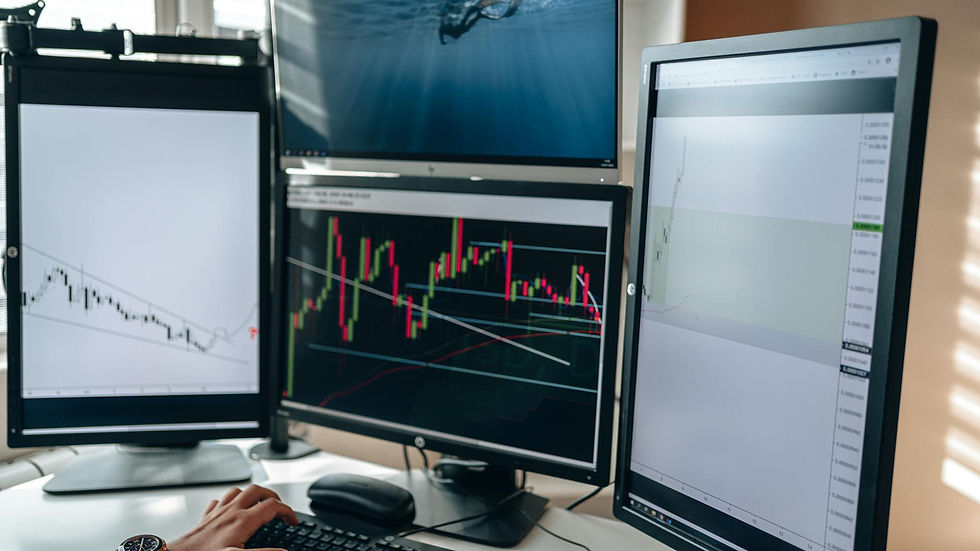
The financial landscape is undergoing its most profound transformation since the advent of electronic trading. Gone are the days when intuition alone guided the allocation of significant capital. Today, success in navigating the volatility and complexity of global financial markets hinges on leveraging computational power. The integration of sophisticated artificial intelligence is no longer a competitive edge; it is the baseline requirement for high-frequency and institutional trading operations. Understanding the profound implications of AIs role in algorithmic trading is paramount for any serious market participant seeking mastery over global economic flows.
Deciphering the Modern Financial Ecosystem: What Is Happening Now
Explaining what is happening in the global financial markets today requires acknowledging an unprecedented confluence of factors. We are experiencing market structures characterized by fractional liquidity, instantaneous global information transfer, and systemic interconnectedness. Traditional indicators often lag, failing to capture the speed at which sentiment shifts across continents, from the NYSE to the Shanghai Stock Exchange. This environment favors participants who can process terabytes of unstructured data-news feeds, social media sentiment, geopolitical developments-faster than their peers.
The current dynamism stems from several core shifts: rising inflation concerns leading to volatile rate expectations, the integration of ESG mandates affecting capital deployment, and persistent geopolitical instability injecting non-linear risk into commodity and equity markets. These complex, high-dimensional problems defy purely linear analytical approaches, creating a fertile ground for advanced machine learning models to extract alpha.
The Velocity and Volume Challenge
The sheer scale of data now dictates market movement. Consider microsecond fluctuations in forex pairs or the rapid repricing of derivatives following a central bank announcement. Human analysis cannot cope. This necessity drives the reliance on automation, making the technological infrastructure as critical as the trading strategy itself.
The Ascendancy of AIs Role in Algorithmic Trading
The engine driving modern quantitative finance is undoubtedly artificial intelligence. AIs role in algorithmic trading moves far beyond simple rule-based execution strategies; it involves predictive modeling, adaptive optimization, and risk management tailored for hyper-speed environments. Machine learning algorithms are inherently superior at identifying subtle, non-obvious correlations buried within noisy market data.
Predictive Modeling and Feature Engineering
Modern AI trading systems excel at feature engineering. Instead of relying solely on historical price and volume data, these systems ingest alternative data sets. They correlate satellite imagery tracking shipping activity with energy futures, or analyze regulatory filings using Natural Language Processing (NLP) to predict corporate behavior ahead of competitors.
Deep Learning (DL) models analyze time-series data to forecast volatility clusters with high accuracy.
Reinforcement Learning (RL) agents learn optimal execution paths in real time by maximizing cumulative reward based on latency and slippage metrics.
Supervised learning models are used for classification tasks, such as predicting whether a stock will move up or down over the next 50 milliseconds.
These models don't just follow trends; they adapt to changing market regimes. If market volatility spikes, the AI automatically recalibrates its risk exposure and trade size, something a static program cannot do effectively.
Execution Optimization: Beyond Speed
While speed remains crucial, true mastery lies in intelligent execution. An AI algorithm can parse liquidity across multiple venues-dark pools, lit exchanges-and craft an order slicing strategy that minimizes market impact while achieving the best possible average execution price. This dynamic scheduling, powered by predictive modeling of order book depth, saves basis points across billions of dollars in volume, equating to massive profitability.
Strategic Implementation: Mastering Market Mastery with AI Tools
To truly master global markets using AI, practitioners must focus on robust system design, rigorous backtesting, and continuous validation. A poorly implemented AI model, even with brilliant underlying mathematics, introduces catastrophic risk.
Rigorous Model Validation and Backtesting
Overfitting is the nemesis of any quantitative strategy. Simply achieving stellar historical returns is insufficient; the system must demonstrate out-of-sample performance and stability across diverse market conditions. We must test models against synthetic data representing extreme stress events, simulating scenarios that might be 10-standard-deviation anomalies.
Implement walk-forward optimization rather than static parameter tuning.
Employ Monte Carlo simulations to assess the probability distribution of potential drawdowns.
Ensure data lineage integrity, confirming that training data is free from look-ahead bias and survivorship bias.
Integrating AI into Operational Risk Frameworks
The final step in achieving market mastery is integrating the AI’s decision-making process within a comprehensive risk governance structure. This means establishing hard circuit breakers that override the AI if predefined risk parameters, such as maximum daily loss or abnormal correlation levels, are breached. The human must maintain the ultimate supervisory control, even when the execution is fully automated. This balanced approach leverages the computational edge without surrendering fiduciary responsibility.
Frequently Asked Questions
How does NLP specifically help in understanding current global financial market dynamics?
NLP algorithms analyze unstructured data like central bank minutes, corporate earnings call transcripts, and geopolitical news articles to quantify sentiment and extract forward-looking signals that traditional quantitative indicators often miss. This allows for faster reaction to underlying economic narratives shaping market direction.
What is the primary difference between traditional algorithmic trading and AI-powered trading?
Traditional algorithms follow fixed, predefined rules based on explicit human logic, whereas AI-powered systems use machine learning to dynamically adapt their decision-making parameters based on evolving market data patterns and historical performance feedback. AI finds patterns humans cannot easily define or observe.
What is the biggest hurdle institutional investors face when deploying advanced AI trading models?
The biggest hurdle is data quality and overcoming the pervasive risk of model overfitting to historical data, which leads to poor performance during novel market regimes. Rigorous validation protocols and access to clean, diverse data sources are essential mitigation factors.
Can retail traders effectively use AI in their trading strategies today?
While sophisticated institutional tools are largely inaccessible, retail traders can utilize accessible machine learning platforms or specialized APIs to apply simpler predictive models to their existing strategies, focusing on specific asset classes like cryptocurrencies where data signals can be easier to process.
The integration of AIs role in algorithmic trading represents a fundamental shift, not a mere upgrade, in how we approach investment management. By accepting the complexity of explaining what is happening in the global financial markets today as a computational problem, firms unlock layers of efficiency and predictive accuracy previously unattainable. The path forward requires quantitative expertise, infrastructural investment, and an unwavering commitment to rigorous validation. Those who master this technological pivot will define the next era of financial market leadership. Embrace the algorithms, validate them ruthlessly, and secure your position at the forefront of global finance.


Comments